

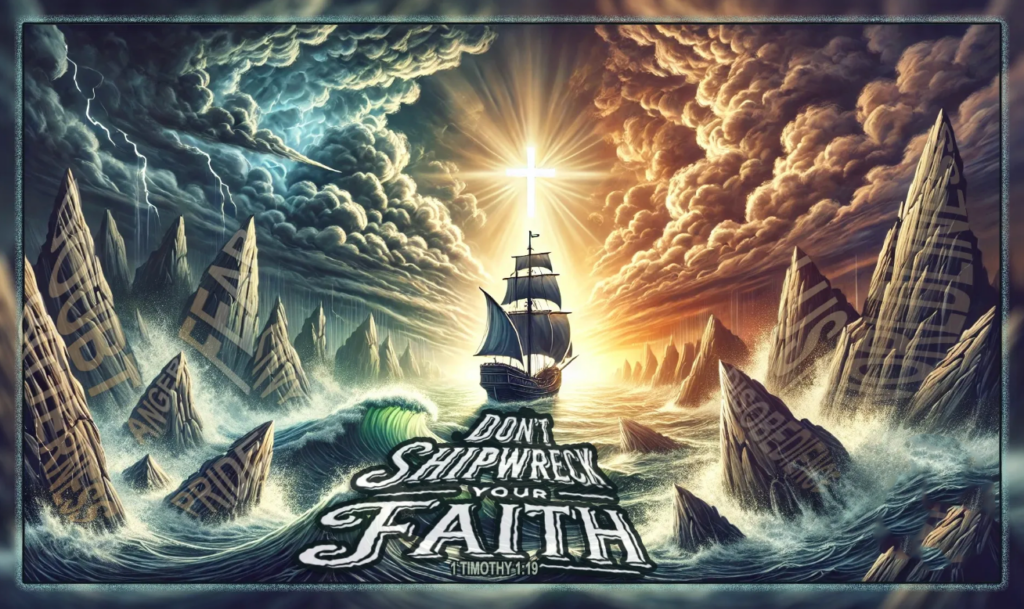
Don’t Shipwreck Your Fait
Main Scripture
“Holding faith and a good conscience. By rejecting this, some have made shipwreck of their faith.”
1 Timothy 1:19 ESV
Objective
This study is about learning how to protect our faith before we drift into dangerous waters. Paul’s warning to Timothy reminds us that faith does not usually fall apart overnight. Most of the time, it drifts little by little through ignored conviction, unhealthy choices, hidden sin, unresolved pain, or distractions that slowly pull our hearts away from God.
The goal is not to make us afraid of failing. The goal is to help us stay anchored in Christ.
Introduction
Imagine your faith as a ship on the water.
It was built with purpose, designed to move forward, and created to carry you through the journey of life with God. But no ship sails through calm water all the time. Storms rise, winds shift, waves crash, and sometimes the greatest danger is not what we can see above the surface, but what is hidden underneath.
That is how spiritual drifting can happen.
Most people do not wake up one day and decide to walk away from God. More often, they get worn down, distracted, offended, discouraged, tempted, or tired. They stop praying as much. They start ignoring small convictions. They excuse things they used to bring to God. They pull away from people who would speak truth, and before long, they realize their heart is not where it used to be.
Paul tells Timothy to hold on to faith and a good conscience because both matter. Faith keeps us trusting God, while a good conscience helps us respond when the Holy Spirit shows us something is wrong.
When we keep pushing conviction away, our hearts can become dull. What once bothered us may start to feel normal, and what once felt dangerous may begin to look harmless.
That is why this warning matters. A shipwrecked faith is not always the result of one huge decision. Sometimes it is the result of many small choices that quietly move us off course.
But here is the good news: God warns us because He loves us. He does not point out danger to shame us. He points it out because He wants to protect us, restore us, and keep us close to Him.
1. What Does It Mean to Shipwreck Your Faith?
A shipwrecked faith is a spiritual life that has been damaged, weakened, abandoned, or pulled far from where God intended it to be.
It may happen through sin, pride, bitterness, false teaching, isolation, fear, disappointment, or simply refusing to listen when God is trying to get our attention.
In 1 Timothy 1:18-20, Paul urges Timothy to hold on to faith and a good conscience. That means our belief in God and our willingness to obey Him are connected. We cannot keep saying we trust God while also refusing to respond when He corrects us.
A good conscience is tender toward God. It notices conviction. It pays attention when something feels spiritually off. It does not make excuses for sin or pretend compromise is wisdom.
But when a person keeps ignoring the Holy Spirit, the heart can start to harden. The first compromise may bother them deeply, but the next one becomes easier. After a while, they may stop calling it compromise at all.
That is how drifting works: a neglected prayer life starts to feel normal, hidden habits remain unconfessed, offenses harden into bitterness, wrong relationships become easier to justify, and small lies open the door to bigger compromises until a person no longer notices how far they have moved from God.
This is why Paul uses such a strong image. A shipwreck is serious. Something valuable has crashed because it went off course, ignored danger, or failed to stay anchored.
Still, a shipwrecked faith does not mean a person is beyond God’s reach. God can restore what has been broken, but wisdom teaches us to pay attention before the crash happens.
Reflection Question:
Is there an area of your life where God may be trying to warn you, correct you, or pull you back toward Him?
2. Fifteen Ways Faith Can Be Shipwrecked
These are some of the ways faith can slowly drift off course. Some are obvious, while others are quiet enough to go unnoticed for a long time.
1. Doubt
Doubt becomes dangerous when it is allowed to take over our thoughts instead of driving us back to God.
Having questions does not mean you have failed. Many strong believers have walked through seasons of wrestling, wondering, and waiting. The problem comes when doubt turns into distrust, and instead of bringing our questions to God, we let them pull us away from Him.
James 1:6-8 compares the doubting person to a wave of the sea, blown and tossed by the wind. That picture reminds us how unstable our hearts can become when we are ruled by uncertainty.
Faith does not mean we understand everything. It means we keep holding on to God even when we do not.
2. Pride
Pride tells us we can handle life without depending on God.
It may sound like confidence, but underneath it is self-reliance. Pride does not like correction, does not want help, and does not think repentance is necessary. It can make us trust our own judgment more than God’s Word.
Proverbs 16:18 says, “Pride goes before destruction, a haughty spirit before a fall.”
Pride is dangerous because it can make a person feel strong while they are actually becoming spiritually vulnerable.
3. Fear
Fear can talk us out of obedience.
It tells us to protect ourselves, assume the worst, avoid risk, and stay where life feels safe. Fear may feel reasonable, especially when the storm is real, but it becomes a problem when it speaks louder than God’s promises.
Isaiah 41:10 reminds us that God says, “Do not fear, for I am with you.”
Faith does not pretend the storm is not there. It simply remembers that God is there too.
4. Anger
Anger becomes dangerous when it is left unresolved.
Ephesians 4:26-27 tells us not to let the sun go down while we are still angry and warns us not to give the devil a foothold. That means anger can become an open door if we refuse to deal with it.
Sometimes anger is pointing to something painful, unfair, or unresolved. But if we let it sit too long, it can turn into resentment, harshness, revenge, or bitterness.
A heart can be wounded and still need healing before anger becomes the thing steering the ship.
5. Greed
Greed is not only about money. It is the desire for more when “more” begins to take God’s place.
It can show up as a craving for success, comfort, attention, possessions, security, influence, or control. The problem is not having needs or goals. The danger comes when gain becomes more important than obedience.
First Timothy 6:10 warns that the love of money is a root of all kinds of evil.
When the heart starts chasing what it wants more than it seeks God, faith begins to drift.
6. Envy
Envy makes us resent what God is doing in someone else’s life.
It can be hard to celebrate another person’s blessing when we are still waiting for our own breakthrough. But envy slowly turns the heart sour because it focuses on what we do not have instead of trusting God with what He is doing.
James 3:16 says that where envy and selfish ambition exist, there will be disorder and every evil practice.
A healthy heart can say, “God, I thank You for what You are doing for them, and I trust You with what You are doing in me.”
7. Lust
Lust lets desire lead without surrender.
It promises comfort, pleasure, escape, or control, but it often leaves shame, secrecy, and distance from God behind. Lust does not only affect the body. It shapes the heart, trains the mind, and weakens spiritual clarity.
First Thessalonians 4:3-5 calls believers to holiness and self-control.
God does not call us to purity because He wants to take life from us. He calls us to purity because He knows what sin destroys.
8. Disobedience
Disobedience is not always loud rebellion. Sometimes it looks like delay, excuses, partial obedience, or doing almost everything God said while still holding one thing back.
First Samuel 15:22 reminds us that obedience is better than sacrifice.
God is not looking for religious performance while our hearts resist His instruction. Every time we obey, trust grows stronger. Every time we ignore Him, drifting becomes easier.
9. Idolatry
Idolatry happens when something takes the place only God should have.
It can be a relationship, dream, ministry, habit, comfort, image, career, opinion, or desire for control. Most idols do not look like idols at first. They usually look like something good that slowly becomes too important.
Exodus 20:3 says, “You shall have no other gods before me.”
One way to recognize an idol is to ask, “What am I afraid to lose, and what am I willing to disobey God to keep?”
10. Apathy
Apathy is when we become spiritually careless.
We may still believe in God, but prayer becomes rare, Scripture becomes optional, worship becomes routine, and conviction becomes easy to ignore. Apathy does not always feel like rebellion. Sometimes it feels like tiredness, distraction, numbness, or being too busy.
Revelation 3:15-16 warns against being lukewarm.
Faith is like a fire. If we stop tending it, the flame can grow weak.
11. Deception
Deception is dangerous because it does not always look like a lie at first.
Sometimes it sounds reasonable. Sometimes it feels comforting. Sometimes it even seems spiritual. But if it does not line up with God’s Word, it can lead the heart away from truth.
Second Corinthians 11:14-15 warns that Satan disguises himself as an angel of light.
The best way to recognize deception is to know the truth well. When we are grounded in Scripture, we are less likely to be pulled off course by something that only sounds right.
12. Bitterness
Bitterness begins with pain, but it grows when resentment is left unchecked.
Hebrews 12:15 warns that a bitter root can grow up and trouble many. That image matters because roots usually grow below the surface before anything shows above ground.
A bitter person may feel justified because the wound was real, and sometimes it was. But bitterness does not heal the wound. It keeps the pain alive and lets it spread into our words, decisions, relationships, and prayers.
Forgiveness does not mean the hurt was okay. It means the hurt no longer gets to captain your life.
13. Laziness
Spiritual laziness happens when we neglect what keeps faith strong.
A person cannot keep skipping prayer, Scripture, worship, repentance, and fellowship while expecting faith to stay healthy. Growth takes attention. What we stop cultivating usually weakens over time.
Proverbs 13:4 reminds us that the soul of the diligent is richly supplied.
Faith does not grow by accident. It grows when we keep showing up with God.
14. Isolation
Isolation pulls us away from encouragement, correction, support, and community.
Hebrews 10:24-25 tells believers not to give up meeting together, but to encourage one another. This is important because hidden battles get heavier when they are carried alone.
The enemy often works in isolation. When we withdraw from people who love God and love us, we become easier to discourage, deceive, or overwhelm.
God did not design us to sail alone.
15. Worldliness
Worldliness happens when culture starts shaping us more than Christ.
It may show up in our priorities, entertainment, language, relationships, goals, attitude, or definition of success. It does not always look dramatic, but over time it can make compromise feel normal and obedience feel extreme.
Romans 12:2 tells us not to conform to the pattern of this world, but to be transformed by the renewing of our minds.
Faith stays steady when Christ sets the direction.
3. How to Stay Afloat
The good news is that God does not leave us without help. He gives us what we need to stay anchored when life becomes rough.
Anchor Yourself in God’s Word
Psalm 119:105 says, “Your word is a lamp for my feet, a light on my path.”
God’s Word gives direction when we feel confused, correction when we drift, and encouragement when the journey feels heavy. A ship without direction is vulnerable to every current, and a believer without Scripture is more easily pulled by emotion, temptation, and deception.
Develop a Strong Prayer Life
Philippians 4:6-7 reminds us to bring everything to God in prayer.
Prayer keeps the heart connected to Him. It is where we confess, surrender, listen, ask for help, and receive peace for what we cannot handle alone.
Stay Accountable
Ecclesiastes 4:9-12 teaches that two are better than one because they can help each other up.
Accountability is not about embarrassment or control. It is protection. We all need people who can encourage us, pray with us, and lovingly tell us the truth when we are drifting.
Keep Your Eyes on Jesus
Hebrews 12:2 tells us to fix our eyes on Jesus, the author and perfecter of our faith.
Storms feel bigger when they become our focus. Jesus does not always remove every wave immediately, but He steadies us in the middle of them. When we keep looking to Him, panic does not get to lead.
Repent and Renew
First John 1:9 promises that if we confess our sins, God is faithful and just to forgive us and cleanse us from all unrighteousness.
Repentance is not the end of the journey. It is the way back to the right course. When we fall, drift, or make wrong choices, God invites us to return instead of sinking deeper into shame.
A ship that turns back can still be guided safely home.
Conclusion
Paul’s warning in 1 Timothy 1:19 is serious, but it is also merciful. God does not want us to drift into destruction, so He teaches us how to recognize danger before it wrecks our faith.
Doubt, pride, fear, anger, greed, envy, lust, disobedience, idolatry, apathy, deception, bitterness, laziness, isolation, and worldliness can all pull the heart away from God if they are left unchecked.
But we do not have to live afraid of failing.
We can stay anchored.
Hold on to faith. Protect a good conscience. Listen when God corrects you. Return quickly when you drift. Stay close to His Word, remain honest in prayer, walk with godly people, and keep your eyes fixed on Jesus.
The waters may not always be calm, but Christ is faithful to guide what is surrendered to Him.
Reflection Questions
- Which danger from this study do you need to pay closer attention to right now?
- Is there an area where you have been ignoring conviction or delaying obedience?
- What helps you recognize when your heart is beginning to drift from God?
- Who can encourage you, pray with you, or help keep you accountable in this season?
- What is one step you can take this week to strengthen your faith?
Closing Prayer
Heavenly Father, thank You for the gift of faith and for loving us enough to warn us when danger is near.
Help us hold tightly to You and protect what You have placed within us. Give us wisdom to recognize anything pulling our hearts away from truth, and give us humility to respond when You correct us.
Strengthen us through Your Word, deepen our prayer lives, and surround us with people who help us follow You faithfully. When storms come, teach us to keep our eyes on Jesus instead of the waves around us.
If we have drifted, help us return quickly. If we have compromised, lead us into repentance. If our faith feels weak, remind us that You are strong enough to steady us.
Guide us through the seas of life, and keep our hearts anchored in Christ.
In Jesus’ name, Amen.